
Shark attacks are most often random occurrences, distributed sporadically over time and locations. There are occasional exceptions, however, with multiple shark attacks occurring in the same location over non-distinct periods of time. Experimental evidence on shark cognition has shown that sharks can learn and remember specific locations and images that lead to food.
From November 30th to December 5th 2010, 5 unprovoked shark attacks occurred along an 8km stretch of coastline in Sharm-El-Sheikh, Egypt. Four of these attacks took place within 24hrs of each other, suggesting the possible convergence of environmental factors as a catalyst.
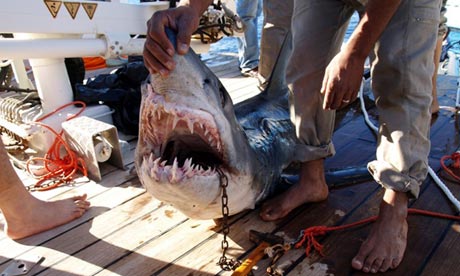 |
| The shortfin mako shark caught by authorities, thought to be the responsible for 2 of the attacks. |
 |
| Oceanic Whitetip Shark |
A group of five scientists found that higher than average water temperatures, local dive operations, and sheep carcass dumping may have triggered the shark attacks.
Surface temperatures in the area usually range from 19 ˚C - 23 ˚C, but that week they were upwards of 28 ˚C to 29 ˚C. Shark metabolism is often correlated to temperature, so that as water temperatures rise shark metabolism increases. Therefore, in the warmer than average water the sharks metabolism would have been higher leading to a greater need for food and may have led the sharks to hunt in areas they usual do not.
Each victim had multiple bite wounds suggesting a strong feeding behavior trigger and it is likely that these sharks had previously been fed by dive operators (which is now illegal in the area). Dive operators will feed sharks by hand from a satchel of food tied to the waist above their buttocks,, drawing the sharks in close for guests to see and take photos. The wounds sustained by three of the victims include severed hands and buttock tissue, and is consistent with the theory that the sharks were looking for food from areas associated with prior feedings by divers.
In addition, sheep carcasses had been dumped within 2km, with some drifting closer or even washing ashore, of the coastline near the time of the attacks. This may have lured sharks closer to shore than they usually come.
All of these factors, and possibly more, collectively are most likely what led to the five shark attacks within such a short period of time along the short stretch of coastline.
Levine, M. , Collier, R. , Ritter, E. , Fouda, M. and Canabal, V. (2014) Shark Cognition and a Human Mediated Driver of a Spate of Shark Attacks. Open Journal of Animal Sciences, 4, 263-269. doi: 10.4236/ojas.2014.45033

No comments:
Post a Comment